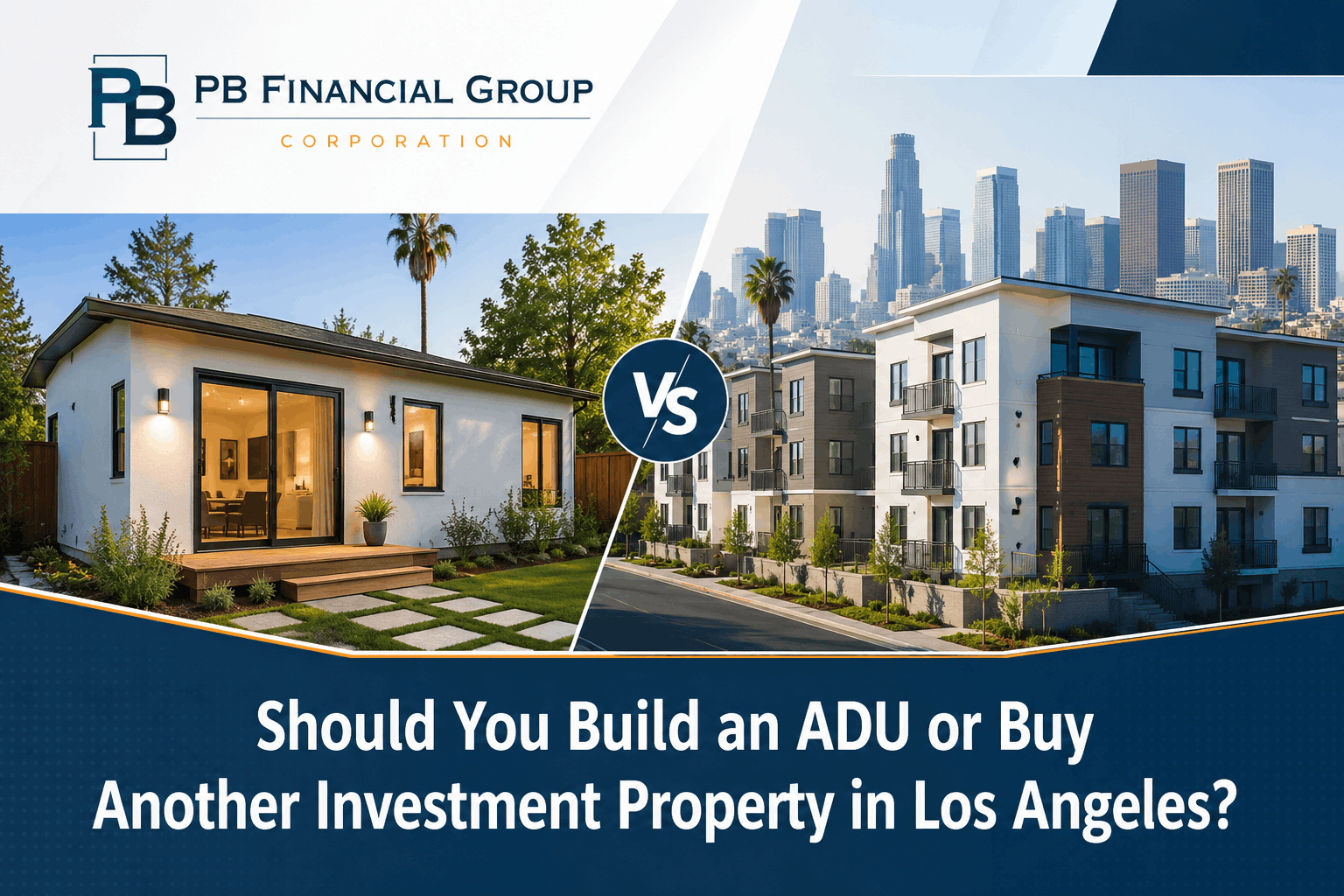
ADU or Another Investment Property: Where Should Your Capital Go Next?
Every real estate investor eventually reaches a point where the question is no longer whether to invest, but where to invest next. After building equity in an existing property or accumulating available capital, many California investors find themselves weighing two very different opportunities: improving a property they already own by constructing an Accessory Dwelling Unit or using that same capital to purchase another investment property and expand the portfolio.
At first glance the comparison seems straightforward. An ADU creates another income-producing unit on an existing property, while a new acquisition adds an entirely separate asset capable of generating rental income and long-term appreciation. The decision, though, is rarely as simple as comparing construction costs against a purchase price, because sophisticated investors treat it as a capital allocation decision. Every dollar committed to one opportunity becomes unavailable for another, so rather than asking which investment looks more attractive today, experienced investors ask which option is most likely to strengthen the portfolio over the next ten or twenty years, once financing costs, cash flow, appreciation, liquidity, and risk are all weighed together.
That perspective matters more in Southern California today than it did a few years ago, as rising construction costs, higher insurance premiums, and fluctuating interest rates have changed how investors evaluate both paths. An ADU that made sense several years ago may deserve fresh analysis now, just as an acquisition may present value beyond the rental income it produces. At PB Financial Group, conversations with California investors typically begin before financing is discussed at all, because investors are trying to determine whether their capital should improve an existing asset or acquire another one, and financing should support that decision rather than drive it.
The Real Question Is Where Your Capital Creates the Greatest Long-Term Value
Many comparisons between ADUs and acquisitions focus on features rather than financial outcomes, weighing rental income or purchase price as though each investment exists independently. Professional investors approach it differently, because they know they aren’t comparing two real estate products, they’re comparing two competing uses of the same capital. An investor with roughly $300,000 available could fund an ADU and increase income without acquiring another parcel or use that same capital as the down payment and reserves on a duplex or value-add property elsewhere in Southern California. The more meaningful question is which opportunity produces the stronger overall return once every variable affecting long-term performance is accounted for.
That analysis has to look beyond projected rental income to expected appreciation, financing costs, available liquidity, tax implications best discussed with a tax advisor, ongoing maintenance, and the flexibility each option preserves for future acquisitions. These variables rarely show up in an online calculator, yet they often decide whether a project outperforms the alternative. Opportunity cost is the piece most often skipped entirely: choosing one project almost always means giving up another, so an ADU may produce excellent cash flow, but if that same capital could reasonably generate greater returns through an acquisition instead, the comparison deserves a deeper look than rental income alone provides.
Cash Flow Should Never Be Evaluated in Isolation
One of the main draws of an ADU is the ability to increase monthly rental income without buying another property. In many Los Angeles neighborhoods a well-designed ADU can put an underutilized backyard, garage, or oversized lot to work, unlocking added value from an asset already in hand. Experienced investors, however, rarely judge an investment by its first-year income alone, since an ADU can require months of planning, permitting, and construction before it produces its first dollar of rent. During that stretch, capital sits committed to a project generating no return, while construction costs, financing expenses, and delays quietly erode projected profitability.
Acquiring another property carries a different profile. Rental income may begin immediately if it’s already occupied, and the investor gains exposure to appreciation on a separate asset entirely, sometimes alongside upside from renovation or better management. In some cases an acquisition outperforms an ADU despite similar monthly cash flow, simply because appreciation and equity growth happen across a new asset rather than an improvement layered onto an existing one. This is why experienced investors treat cash flow as only one input, weighing it alongside equity creation and how each investment fits the broader portfolio.
Risk Concentration Is the Trade-Off Few Investors Price In
Real estate investing is often framed as a search for the highest possible return, but professional investors spend just as much time managing risk as pursuing profit. An ADU is a concentrated bet, since the added rent, increased value, and construction cost are all tied to a single parcel. If the neighborhood appreciates the owner benefits fully; if costs run over, the entire investment absorbs it. Buying another property works differently, expanding the portfolio itself with rent from a new location, appreciation on a separate asset, and potentially more refinancing flexibility as equity builds elsewhere.
Some investors prefer concentrating capital into fewer properties they know well and manage closely; others want a broader footprint across neighborhoods and property types. The right answer depends less on which investment looks more profitable today and more on which strategy matches the investor’s long-term objectives and risk tolerance.
Financing Structure Can Change the Outcome Entirely
How each option gets financed is often the most underweighted variable in this decision, since two identical opportunities can produce very different outcomes depending on structure. A homeowner who secured a first mortgage years ago at a historically low rate may find that refinancing to access equity substantially raises borrowing costs, while preserving that first mortgage and layering in a second-position loan produces a stronger overall result instead. The investment hasn’t changed; the financing strategy has.
The same logic applies to acquisitions. An investor who identifies a value-add property below market may use short-term financing to move quickly, then transition into a longer-term loan once renovations are complete and rents have stabilized. The initial cost is higher, but securing a discounted property before another buyer does can meaningfully improve long-term performance. Financing should never drive the decision, but structured well, it is often what turns a good investment into an exceptional one.
How Professional Investors Sequence the Decision
The biggest difference between newer investors and experienced ones is usually sequence. First-time investors often start by asking which option sounds more attractive, excited about an ADU after reading about the housing shortage, or about another rental because owning more real estate feels like it automatically builds wealth. Experienced investors start elsewhere: they define the objective first, whether that’s cash flow, appreciation, liquidity, reduced risk, or future borrowing capacity, and only then evaluate specific opportunities against it.
That discipline produces conclusions that aren’t always intuitive. An ADU might generate excellent returns for one investor while representing a missed opportunity for another with different goals. Buying another property simply because financing is available may not strengthen a portfolio at all if the existing property already offers a stronger path to value. The strategy behind the investment supplies the answer, not the investment itself.
Two Investors, Same $300,000, Two Different Right Answers
Two investors, each with roughly $300,000 to deploy, illustrate the point well. The first owns a Los Angeles duplex with a large backyard suited to an ADU, strong rental demand, well-understood construction costs, and an existing relationship with a contractor, all of which reduce the project’s uncertainty. The second is evaluating a small multifamily property elsewhere in Southern California, priced below market because it needs cosmetic work and better management. It requires more capital upfront and adds the responsibilities of a new property but opens the door to income from multiple units and appreciation on a separate asset entirely.
Neither investor is making the wrong call; each is pursuing the strategy that fits their circumstances and objectives. Real estate investing isn’t about finding one approach that works for everyone. It’s about identifying the strategy that fits your capital, risk tolerance, and where you already have an edge.
Sometimes the Better Move Is to Wait
Patience gets surprisingly little attention in this conversation. Investors often feel pressure to deploy capital immediately, especially when headlines cover rising rents or limited inventory, but committing too quickly can create risk that a fully evaluated project would have avoided. An ADU may deserve more time if construction costs are uncertain or permitting could delay profitability, and buying another property just because financing is available may not make sense if pricing no longer supports acceptable returns. Preserving capital is itself an investment decision; waiting for a stronger opportunity or better terms can outperform moving forward simply because the funds are sitting there. The goal isn’t the next transaction; it’s the next transaction that strengthens the portfolio for years to come.
Frequently Asked Questions
Is building an ADU always more profitable than buying another rental property?
Not necessarily. The answer depends on construction costs, projected rental income, financing expenses, local market conditions, and the returns available from other opportunities. Each investment should be evaluated individually rather than by general assumption.
Does an ADU always increase a property’s value?
Usually, because it adds living space and rental income potential, but the increase in value doesn’t always equal the full cost of construction. Investors should weigh expected rental income against projected return before starting a project.
When does purchasing another investment property make more sense than building an ADU?
When it offers stronger long-term appreciation, better diversification, immediate rental income, or clearer opportunities to add value through renovation or improved management.
How much does financing structure actually affect the outcome?
Significantly. The same investment can produce very different results depending on interest rate, loan structure, available equity, and repayment strategy, which is why financing deserves its own evaluation alongside the investment itself.
What should an investor evaluate before committing to either option?
Projected cash flow, total project costs, financing expenses, expected appreciation, available liquidity, construction or acquisition risk, and how the investment supports the broader portfolio. Looking past first-year returns tends to produce stronger long-term decisions.
Making the Right Decision for Your Investment Strategy
Building an ADU and purchasing another investment property are both proven ways to grow wealth through California real estate. The better choice depends less on the investment itself and more on how it fits your overall financial plan, weighing opportunity cost, financing structure, appreciation, cash flow, and portfolio objectives together. Rather than asking which strategy is universally better, the more useful question is which one best supports your next stage of growth, and the answer will differ for every investor and every portfolio.
Whether you’re weighing an ADU, another rental acquisition, or a different opportunity elsewhere in California, taking the time to work through the complete financial picture leads to more confident decisions. If you’re evaluating your next move and want to talk through financing options that fit your long-term objectives, PB Financial Group can help. Since 2006, our team has worked with California real estate investors, developers, and property owners to structure financing for acquisitions, renovations, construction, and portfolio growth.
Call (877) 700-3703 to discuss your investment goals with one of our experienced lenders or visit www.CalHardMoney.com to learn more about our lending programs.